

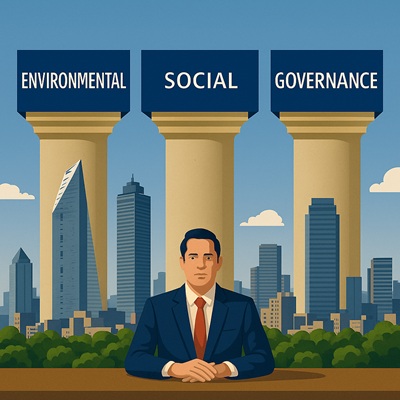
Jorge Andrés Casillas Soto, General Counsel & Director of Corporate Affairs at Gaya Sinergia Constructiva in Mexico explains why ESG is no longer a voluntary ideal in Mexico’s real estate sector – but a board-level obligation tied directly to risk, capital, and long-term project viability.
In Mexico, ESG is still often discussed as if it were a voluntary initiative or a public-relations concept. For the real estate sector, that perspective is outdated. Whether developing housing, industrial parks, logistics hubs or data centres, ESG considerations have become part of core business risk. They influence access to capital, regulatory certainty and the long-term viability of projects. In this context, ESG is not a trend. It is a business responsibility.
Nearshoring has accelerated foreign investment in industrial and digital infrastructure across Mexico. Many of the funds now entering the market operate under strict ESG standards and assume that local projects will align with them. Although Mexican law does not use the term “fiduciary duty” in the same way as the United States, Mexican directors are legally required to act with diligence and care in the company’s best interest. When a real estate project ignores material environmental, social or governance risks, that legal duty is put at risk, whether explicitly named or not.
Environmental exposure is one of the most concrete and immediate areas of concern. Mexican law holds property owners responsible for land contamination even if they did not cause it. A site acquired without proper environmental due diligence can create large remediation liabilities, regulatory challenges and operational interruptions. This matters particularly in industrial corridors and logistics regions where prior land use may not be well documented. In such environments, a basic environmental review is not enough. Boards must ensure the company understands the condition of the land it acquires and the potential obligations it inherits.
Water availability has become an equally critical variable. Regions such as Nuevo León, the Bajío and Baja California face meaningful water pressure. For data centres, which depend on reliable cooling infrastructure, the long-term availability of water and power is essential. Without a clear plan for resource access and infrastructure, a project may struggle to operate sustainably. The same logic applies to housing developments. Water rights and supply are no longer technical permitting matters; they are strategic considerations that influence whether a project can function over time.
The social dimension presents additional risks. A significant portion of Mexican land originates from ejido or communal property regimes. Verifying land title and regularisation processes is not a formality. Developers that fail to review these issues have faced community disputes, work stoppages and reputational harm. The lesson is straightforward: land in Mexico requires deeper verification. It cannot be treated as a standard land-record exercise.
“Boards in Mexico do not need to become ESG experts. What they do need is clarity.”
Labour practices in construction also matter. Investors and regulators increasingly expect companies to ensure that contractors follow labour laws and safety standards. In Mexico, companies can face responsibility for contractor non-compliance. A construction incident or labour dispute can quickly escalate to broader scrutiny. This dimension of ESG is not abstract. It affects the day-to-day execution of real estate projects and the legal risk profile of the companies behind them.
Governance ties these issues together. Real estate boards in Mexico must receive clear, verifiable information regarding environmental compliance, water rights and infrastructure, land title status, labour compliance, permitting and energy efficiency. General sustainability statements are not sufficient. Claims about “green buildings” or “responsible development” must be based on documented practices. A sustainability claim made in Mexico can have consequences outside the country, especially when a project is backed by an international investor. Accuracy and evidence matter.
The role of in-house counsel is central in this environment. Legal teams must go beyond reviewing titles and drafting agreements. They are responsible for ensuring that environmental and social risks are assessed early, that due diligence processes are robust and that boards receive the information needed to make sound decisions. The objective is not to introduce complexity into projects. The objective is to ensure that projects move forward in a manner that is legally secure and operationally sustainable.
Boards in Mexico do not need to become ESG experts. What they do need is clarity. They need to understand whether the land they are acquiring is clean and legally regularised, whether the project has access to sufficient water and energy, whether contractors meet labour obligations and whether the company’s public statements align with documented actions. These are fundamental governance questions. If any of them triggers uncertainty, the board must ask for deeper review. Proper oversight is not obstruction. It is part of responsible leadership.
Mexico’s real estate sector is entering a period of significant opportunity. Industrial demand is rising, data centres are expanding, and housing needs remain substantial. At the same time, expectations have shifted. Investors, regulators, and communities increasingly expect real estate companies to demonstrate responsible practices. ESG has moved from a symbolic concept to a practical requirement for boards.
Good governance today means understanding the environmental and social context of every project, asking the right questions, insisting on proper due diligence, and supporting long-term operational stability. Managing these factors is not a burden; it is a competitive advantage that strengthens resilience, protects value, and builds credibility with investors and stakeholders.
For boards in Mexico, ESG considerations are no longer optional. They are part of the duty to oversee risk, protect the organisation, and lead with long-term responsibility.
Be part of a growing global community committed to advancing in-house legal leadership.

Alexander Shevchenko, Chief Legal Officer at WEB PAY, shares a practical framework for dissenting with influence. He outlines how GCs and senior in-house lawyers can...
Learn more about When and how to disagree with bosses or other influential people at work?

Aleksandra Polak, Assistant General Counsel at Billtrust in USA, explores how modern in-house teams can outperform law firms not by working harder, but by working...
Learn more about Faster and more expert than law firms: the new playbook for in-house legal

General Counsel
GAYA Sinergia Constructiva
Mexico