

Fatima Correia da Silva, Global Head of Compliance at Elementis Global in Portugal explores how Minimum Viable Governance enables organisations to move faster while meeting rising regulatory expectations.
You don’t need more policies. You need a governance stack that ships – fast, auditable, and right‑sized for what regulators actually expect in 2025.
Across Europe, three forces are converging: the AI Act’s phased obligations, stronger NIS2 accountability, and a streamlined CSRD. The message is clear: build capable minimums that work now and scale later. Minimum Viable Governance (MVG) is that discipline.
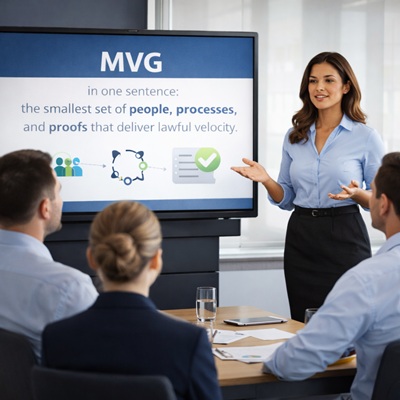
MVG in one sentence: the smallest set of people, processes, and proofs that deliver lawful velocity.
1) Start with a one‑page risk model
Most legal teams drown in frameworks before they deliver assurance. MVG flips the sequence. Build a simple risk register that maps the few obligations that truly matter to your business: for AI systems, cybersecurity and operational resilience, and sustainability disclosures. Keep controls count low (think 10), make ownership explicit, and define a single source of truth for evidence. If you can’t show what the control is, who owns it, and where the proof lives in under a minute, it’s not MVG.
2) Fix intake and decision rights (that’s where speed lives)
The narrative that “legal is slow” persists because the system around legal is slow. MVG tackles the front door: structured intake, lightweight SLAs, and clear decision ladders. When the business knows how to bring a matter in, who decides at each threshold, and what timelines apply, cycle‑time collapses. MVG teams publish a two‑page “How to Work With Legal & Compliance” guide and ruthlessly maintain it. Speed becomes a property of the system, not the heroics of individual lawyers.
3) Make proofs effortless
Regulators don’t reward volume; they reward verifiability. MVG bakes auditability into the workflow: small templates, single paths, and versioned evidence. For AI, that means a basic inventory of use cases, risk screening questions, and a human‑oversight record that can be pulled on demand. For cybersecurity, it’s incident criteria, escalation steps, and response logs the board actually understands. For sustainability, it’s a right‑sized double‑materiality narrative backed by a handful of metrics that link to how the business really runs.
4) Build “trust architecture,” not just hotlines
Speak‑Up works when people trust the journey: from reporting to closure. MVG teams define a closure SLA, communicate outcomes at the right level, and publish anonymised learnings so the organisation sees improvement, not just counts. It’s remarkable how much misconduct you avoid when your governance system looks like a place that listens, acts, and learns.
5) Enable the board without exhausting it
AI and cyber have become mission‑critical risks. MVG sets a board cadence that focuses on three artifacts: (i) a one‑page risk posture; (ii) exceptions and how they were handled; (iii) a forward look at obligations coming due. No 60‑slide decks. No “policy museums.” Directors get signal, not noise – and you get real oversight without slowing the business.
What changes when you adopt MVG
Metrics that matter (and fit on a page)
Track four numbers: (1) Risk cycle‑time (from intake to decision), (2) SLA adherence, (3) Closure quality (percentage of matters with documented outcome and learning), and (4) Evidence‑of‑control coverage (controls with verified proofs in the last quarter). If any number goes red, MVG says fix the system: don’t throw bodies at the problem.
Start small, ship fast
Pick a single AI use case, a single cybersecurity escalation path, and a single sustainability disclosure theme. Build the minimum controls and proofs, publish the “How to Work With Legal & Compliance” guide, and commit to a 90‑day iteration. MVG is not a project; it’s a muscle. You’ll be surprised how quickly the culture starts treating governance as a way to go faster, not a reason to slow down.
MVG is the GC’s answer to 2025: lean by design, auditable by default, and capable of scaling with the business. If you want speed without losing the plot, start here.
(The views expressed are my own and do not necessarily represent those of my employer.)
Sources used:
Be part of a growing global community committed to advancing in-house legal leadership.

Markus Warmholz, Head of Corporate & International Legal Affairs and Legal Operations at Hartmann Group in Germany, highlights overlooked legal pitfalls that can derail even...

Markus Warmholz, Head of Corporate & International Legal Affairs and Legal Operations at Hartmann Group in Germany, outlines how corporate lawyers can align legal acumen...

Global Head of Compliance
Elementis
Portugal